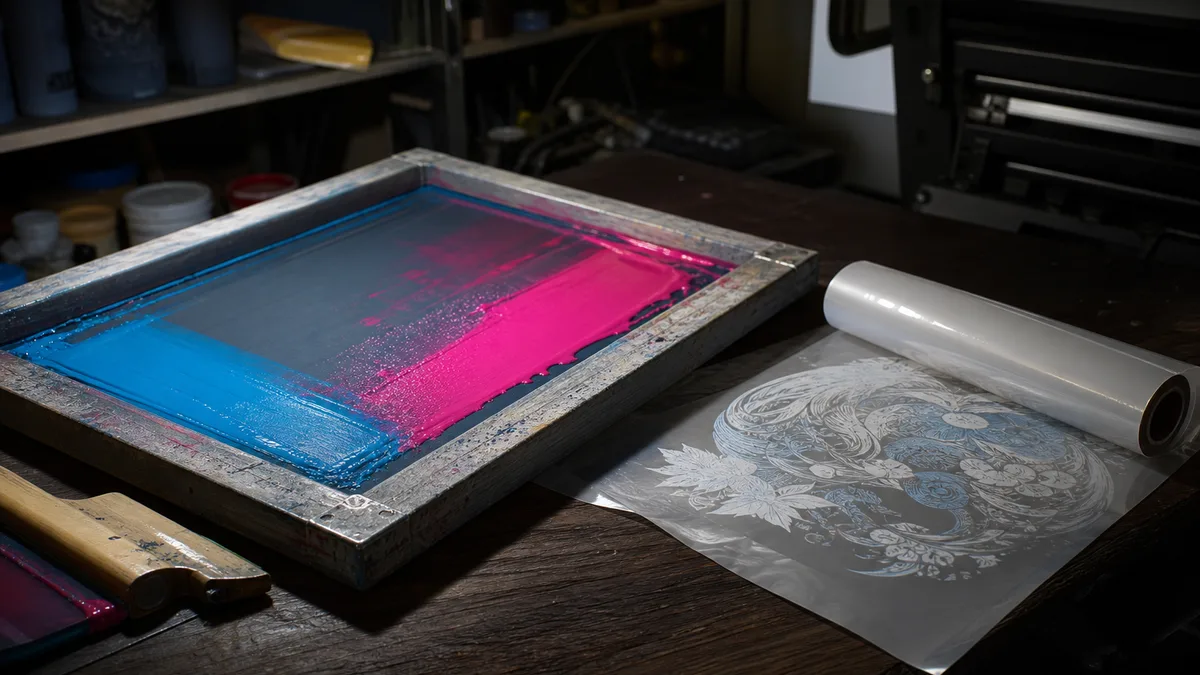

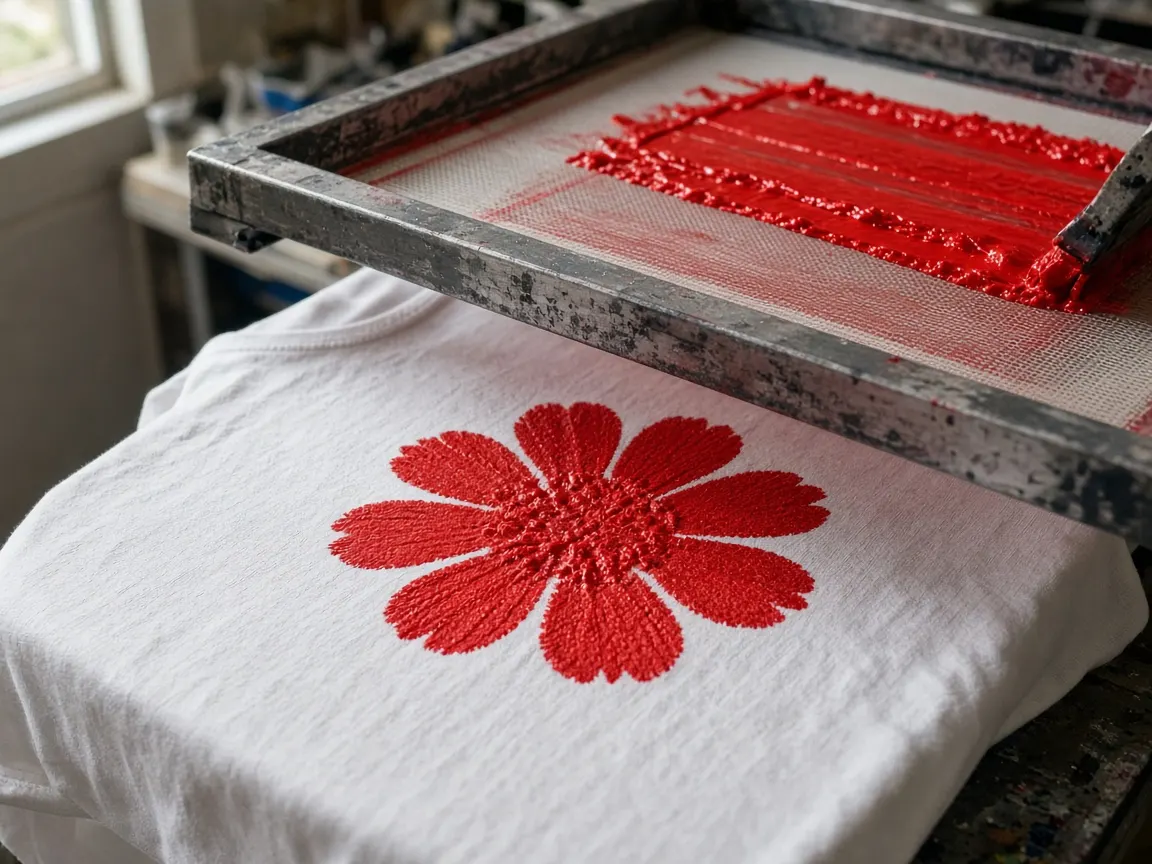
What happens to the mesh
Mesh is stretched on a frame and everything except the drawing is blocked. Ink passes only through the open parts and sits in the cotton. One colour is one pass. Two colours are two screens and a careful lineup. More than six solid colours on one shirt rarely pays: the lineup drifts and making the screens takes longer than the printing.
What artwork a screen accepts
A flat mark, a solid shape, a letter thick enough to hold. A hairline and a gradient from white to red do not live on a stencil. A coarse dot can fake a tone, but that is a compromise, not a photograph. If the file is a portrait or ten skin tones, say it early: that is DTF, not screen printing.
From how many shirts a stencil makes sense
The rough line is about ten identical shirts and up. The screen is made anyway, and on two pieces that prep costs more than the ink. On fifty identical shirts the mark stays even from the first to the last. A repeat a month later uses the same file if you did not change the drawing.
Ink and cloth
On cotton and dense fleece the ink sits in the fibre and takes a normal wash. A thin vest and a hard stretch forgive less: the edge can crack if the cloth is pulled on the body. A dark shirt almost always wants a light underbase under a bright colour, or red turns brown.
Washing
Inside out, no chlorine on the mark, iron away from the print. The first washes do not need maximum heat "to set it". The ink is already fixed in the shop. If the shirts are washed every day, like a shift uniform, write that in the brief. The press and the ink are chosen for frequent wash, not for a shirt worn once.
How to order
Send a vector or a large PNG, the number of colours you see, and how many shirts of each size. Message @dkretov or call +998 90 349 03 64. If the file is a photo, we will say so before the screens, not after. Pickup is in Sergeli, or across Tashkent once the run is packed.
Summary
Screen printing on t-shirts holds one mark across the run. The mesh likes flat colour and a repeat. A photo and a gradient go to DTF. The file and the count pick the method faster than the vague word "printing".